7 Emotional Intelligence Games for Adults, Teams, and Students
Emotional intelligence games give people a practical way to name feelings, question assumptions, listen carefully, and choose a response before reacting. You do not need a paid app or a room full of confident performers: paper, a timer, and a few everyday scenarios are enough. The seven activities below include clear instructions, suggested timings, and discussion questions for adults, employees, teens, and students. If you are also exploring how you understand other people's feelings, an empathy self-reflection tool can offer a separate starting point. Keep that reflection private, and use these games to practice specific behaviors rather than rank anyone's emotional ability.

What emotional intelligence games can help you practice
Emotional intelligence involves recognizing and understanding emotions and using that information to guide responses. Empathy overlaps with it, especially when considering another person's experience, but it is not the whole skill set.
For this guide, activities target four practical areas: noticing your own emotions, managing your response, considering others' perspectives, and communicating thoughtfully. These are useful organizing categories, not a complete assessment model.
Mattingly and Kraiger's 2019 meta-analysis of emotional intelligence training reviewed 58 studies and found a moderate positive effect of formal training on emotional intelligence scores. That does not establish that each game below produces the same result. These are educational practice activities, not validated interventions; judge progress through specific everyday behaviors.
Choose a game that fits your goal and group
Start with one skill you want to rehearse. A group struggling with assumptions needs a different activity from a group learning to listen without interrupting.
| Game | Main practice | Suggested time | Group size |
|---|---|---|---|
| Emotion Word Swap | Emotional awareness | 6 minutes | 2-6 |
| One Event, Three Stories | Perspective-taking | 8 minutes | 2-8 |
| Facts, Guesses, Questions | Social awareness | 8 minutes | 2-8 |
| Listen, Reflect, Check | Active listening | 10 minutes | Pairs |
| Pause-and-Choose Cards | Response regulation | 8 minutes | 2-6 |
| Repair the Conversation | Relationship skills | 10 minutes | Pairs or trios |
| Request Builder | Clear, respectful requests | 8 minutes | 2-8 |
These timings are starting points and include a short discussion. For larger groups, work in pairs or small teams instead of making everyone speak to the whole room.
Each game has a cooperative goal: record observations, check a partner's understanding, or revise a response. Use the completion checks below to guide feedback, not to rank participants. For ongoing practice between sessions, see these daily habits for building empathy.
Set up emotional intelligence group activities without pressure
Explain that participants may pass, write instead of speak, or use an invented example. Do not require personal stories, sustained eye contact, acting, or physical contact. Emotional expression varies across people and cultures; quiet participation is not evidence of low empathy.
Use ordinary situations such as a changed plan, a delayed reply, or a shared task. Avoid turning a current workplace dispute into a public exercise. Keep written notes private and discuss behaviors rather than personalities.
If someone becomes uncomfortable, pause and offer a different role or activity. These games are educational, and persistent emotional distress deserves support from a qualified professional rather than additional group pressure.
7 emotional intelligence games with step-by-step instructions
1. Emotion Word Swap
Practice: Naming emotions more precisely. Materials: Paper and pens.
- Give everyone the same fictional situation: a friend cancels a plan shortly before you leave.
- Each person writes a broad feeling word, then two more specific possibilities. For example, "bad" might become "disappointed" or "relieved."
- Compare answers and explain what extra context would make each feeling plausible.
Debrief: What changes when you replace a vague label with a more specific word?
There is no single correct emotion. Offer this word bank: disappointed, relieved, worried, frustrated, embarrassed, hopeful. Younger students may draw or point instead of explaining aloud.
Completion check: Each person gives two possible emotions and a reason either could fit.
2. One Event, Three Stories
Practice: Considering different perspectives. Materials: One scenario card.
Use this prompt: someone leaves a group chat without explanation. Each team invents three plausible stories, such as feeling overwhelmed, changing phone accounts, or being upset about an earlier exchange. Then write one respectful question that could clarify the situation.
Debrief: Which story did you assume first, and what information was missing?
The goal is not to excuse every action. It is to notice that an interpretation is provisional. End with a question such as, "I noticed you left the chat. Would you like me to check in another way?" Accept that someone may prefer not to explain.
Completion check: Produce three distinct explanations, each with a missing piece of information. If players debate the correct story, say, "We do not have enough evidence to choose yet." Unlike the next activity, this round practices generating alternatives.
3. Facts, Guesses, Questions
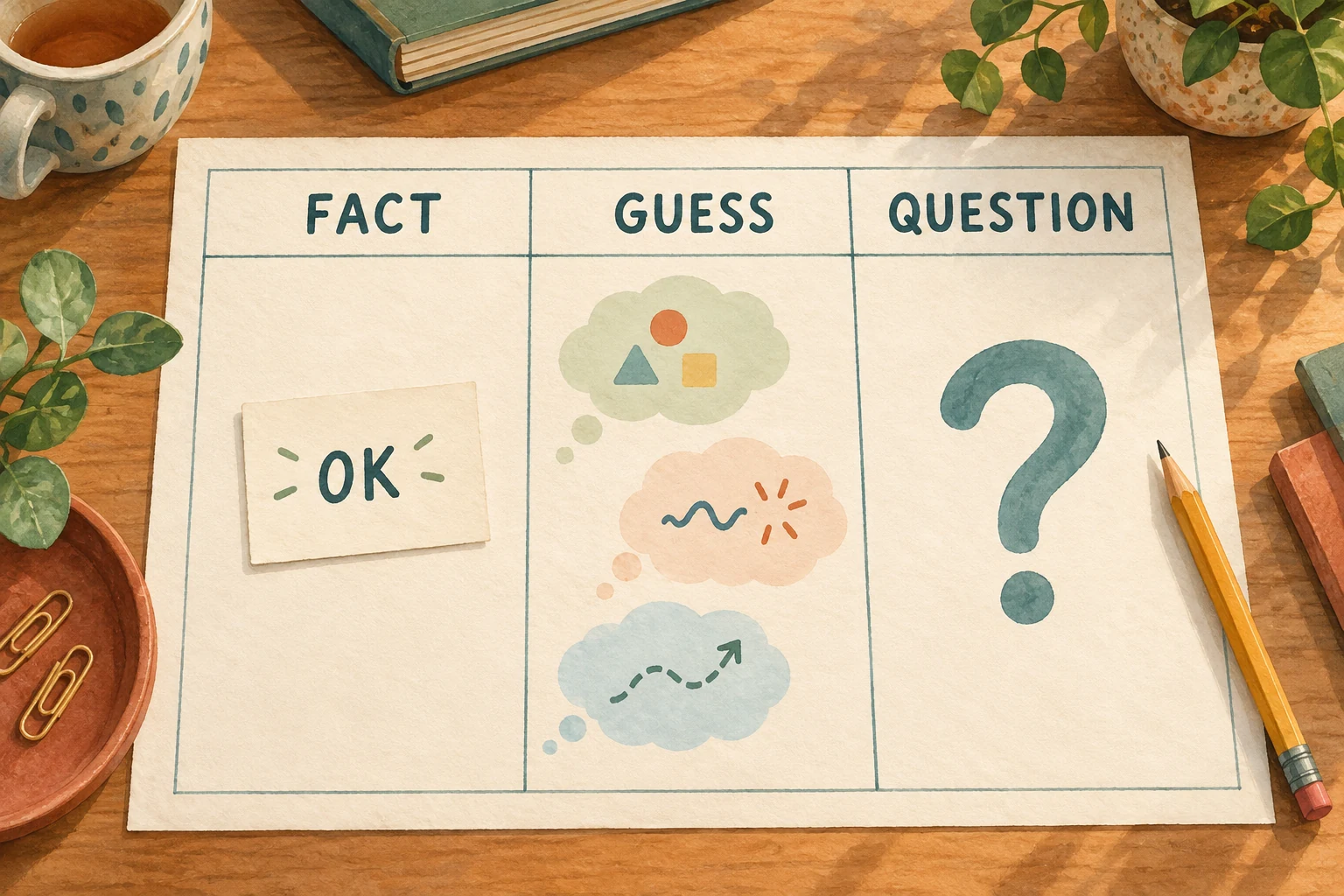
Practice: Separating observations from assumptions. Materials: Three columns on paper.
Present a scenario: a teammate responds "OK" to a detailed message. Participants fill in:
- Fact: The reply contained one short word.
- Guess: The teammate may be annoyed, busy, or simply brief.
- Question: "Does this plan work for you, or is anything unclear?"
Swap sheets and check whether any guess has slipped into the fact column. "They dismissed me" is an interpretation; the message itself is the observation.
Debrief: How would your response change if you held your guess more lightly?
Completion check: Record one observable fact, label two interpretations as guesses, and write one neutral question. This round practices sorting evidence, rather than generating stories alone.
4. Listen, Reflect, Check
Practice: Understanding before giving advice. Materials: A timer.
- One person describes a mild frustration, real or fictional, for one minute.
- The listener summarizes the event and tentatively names a possible feeling: "The plan changed late, and that sounds frustrating. Have I understood?"
- The speaker corrects or confirms the summary. The listener revises it before offering advice.
- Switch roles, then discuss what helped each speaker feel understood.
Debrief: What did you learn by checking instead of assuming?
Keep the emotional label tentative. A person can appreciate a careful question even when the listener's first guess was wrong.
Completion check: Both partners summarize and invite a correction. If either feels misunderstood, revise once more. These empathy questions for different settings offer additional prompts.
5. Pause-and-Choose Cards
Practice: Creating space before responding. Materials: Scenario cards and paper.
Write a low-stakes trigger on each card, such as receiving an unexpected revision request. Each player draws a card and writes two replies: an immediate impulse and a considered response after a short pause.
For example, "You always change everything" could become, "I am frustrated by the extra work. Which revision matters most, and what deadline is realistic?"
Debrief: What pause cue could you use outside the game: setting down your phone, taking a breath, or drafting before sending?
Do not score people for sounding cheerful. The exercise is about expressing a feeling while choosing a workable action.
Completion check: Write two different replies and identify the pause cue used between them.
6. Repair the Conversation
Practice: Responding after a misunderstanding. Materials: A short dialogue.
Give pairs this exchange: "You changed our shared plan without telling me." "It was easier that way." Ask them to rewrite both lines using a specific observation, an acknowledged impact, and a next step.
One possible repair is: "When the plan changed without a message, I prepared the wrong materials." followed by, "I changed it without checking. That created extra work for you. Let's agree on the next step together."
Read or act out the revision, then swap roles. In trios, an observer notes what changed without rating personalities.
Debrief: Which words made repair easier without asking either person to abandon a reasonable boundary?
Completion check: The revised response acknowledges an action and its impact. This activity addresses an existing rupture; Request Builder rehearses a future agreement.
7. Request Builder
Practice: Turning frustration into a clear request. Materials: Paper strips.
Prepare separate strips for an event, a feeling, and a request. Participants combine them into a sentence: "When the meeting ran over, I felt rushed. Could we reserve the last five minutes for next steps?"
Have a partner check whether the request is specific and possible to answer. "Be more considerate" is difficult to act on; "Please message me before changing our plan" is clearer.
Debrief: Can the other person say no or propose an alternative?
Emotionally thoughtful communication includes negotiation. A request should not become a demand simply because someone names a feeling first.
Completion check: The partner can identify the requested action and offer a realistic alternative. Swap roles and try the revised request.
Adapt the games for adults, employees, teens, and students
For adults, use changed plans or shared responsibilities. In Request Builder, have partners propose two workable arrangements, then choose one. Keep personal examples private.
For employees and teams, use fictional handoffs or feedback messages. In Listen, Reflect, Check, assign a speaker, listener, and observer; rotate roles so seniority does not determine who speaks. Managers should accept corrections. Do not collect personal notes, request test scores, or use performance in appraisals. Games cannot resolve excessive workloads or unfair procedures on their own.
For teens and older students, use fictional group projects or unclear messages. Ask for a written response before pair discussion, then compare how extra context changes an interpretation. Avoid reenacting actual bullying or naming classmates.
For younger students, begin with Emotion Word Swap: read one sentence aloud, offer three emotion words or pictures, and let children point, draw, or pass. Skip written explanations until they suit the group's reading level. Keep classroom games independent of online assessments.
Prepare scenario cards
Use these fictional cards across the activities:
- Changed plan: A friend moves the meeting time without checking with you.
- Brief reply: A teammate replies "OK" to your detailed proposal.
- Shared materials: Someone borrows a shared notebook and returns it late.
- Group project: A student is quiet while others assign the tasks.
For each card, add one detail in a second round: the teammate is between appointments, or the quiet student has not seen the task list. Ask what changes and what remains unknown.
Run a 20-minute session and make a simple action plan
For a first session, spend two minutes explaining participation choices, six minutes on Emotion Word Swap, eight minutes on Facts, Guesses, Questions, and four minutes discussing one behavior to try later. Adjust the pace instead of rushing people to disclose more.
Use the following emotional intelligence action plan template in a notebook.
| Plan field | Example |
|---|---|
| Situation to notice | A colleague sends a brief reply |
| Feeling to name | Uncertain or frustrated |
| Skill to practice | Separate facts from guesses |
| Next action | Ask one neutral clarification question |
| Review point | After three relevant conversations |
| Evidence to record | Whether I checked before assuming |
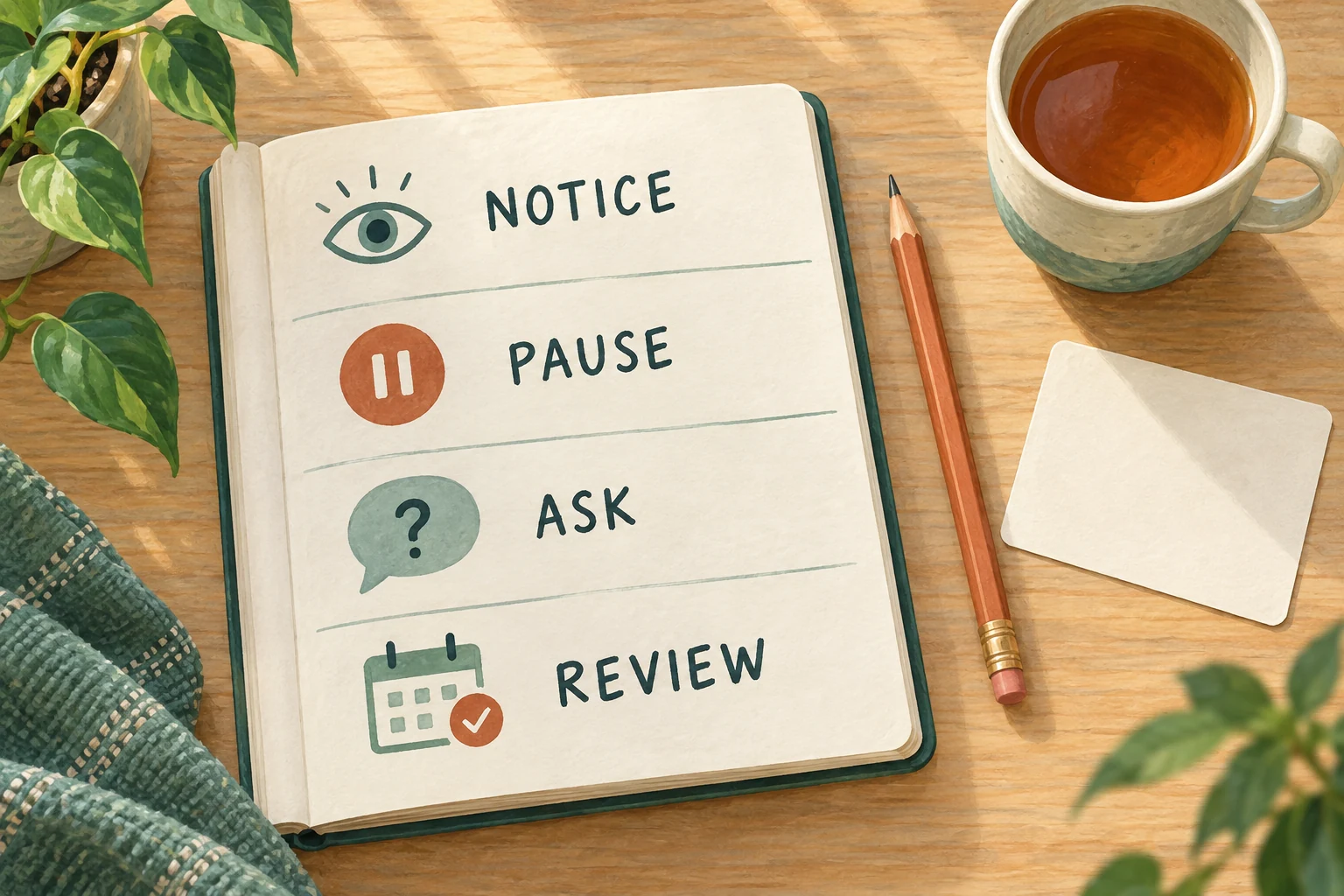
Choose one behavior and review specific examples. Notice when it helped, when it was difficult, and what you would adjust. A higher game score, faster answer, or repeat test result is not proof that everyday communication has improved.
The reminder below summarizes the practice loop: notice a feeling, pause, ask rather than assume, and review what happened.
Carry one emotional intelligence game into everyday conversations
The most useful next step is small: name a feeling more precisely, check one assumption, or reflect back what someone said before offering advice. Repeat the activity with a different fictional situation, then look for an opportunity to use the same skill in daily life.
If you want a separate perspective on your empathy habits, explore an educational empathy assessment as a private reflection aid. Its results are not a clinical evaluation or a judgment of your character. Emotional intelligence games are most practical when they lead to a specific, respectful action you can revisit.
FAQ
What are emotional intelligence games?
They are structured activities for practicing emotional awareness, perspective-taking, response regulation, or communication. A useful game includes a clear task and a short discussion about how the skill applies outside the session.
Which emotional intelligence games work well for adults?
Facts, Guesses, Questions and Listen, Reflect, Check are accessible starting points because they use everyday communication and require little preparation. Select the activity around the behavior you want to practice, rather than assuming one game suits everyone.
Can emotional intelligence be trained?
Research on formal training suggests that emotional intelligence scores can improve. Results vary by program and participant, and a short game is not equivalent to a full training course. Look for changes in specific behaviors over time.
Do these emotional intelligence activities need special materials?
No. The activities in this guide use plain paper, pens, a timer, and fictional scenarios. You can copy the prompts and action plan into a notebook. These are educational activities, not a validated emotional intelligence test.
Can these activities be used remotely?
Yes. Share fictional scenarios in a chat, use a timer, and let participants write privately or talk in pairs. Keep cameras optional and avoid recording personal disclosures. Facts, Guesses, Questions works especially well with text examples.
Should emotional intelligence games be competitive?
Use cooperation rather than public rankings of feelings or empathy. If you add points, award them for following the exercise, such as producing multiple plausible explanations. Never score personal disclosures or treat a guessed emotion as proof of someone's ability.