Empathy Test Psychology: EQ Scales & AI Measurement
Have you ever wondered what makes empathy tick? It’s that invisible thread connecting us, allowing us to feel with others, not just for them. But as a psychology enthusiast, I’ve always been fascinated by a deeper question: how can we actually measure this profound human experience? Taking an empathy test is about more than just curiosity; it’s about unlocking a new level of self-awareness. How can we translate the deeply human experience of empathy into a measurable score?
For decades, psychologists have worked to quantify this trait. Today, technology is pushing the boundaries of what's possible, moving from simple questionnaires to nuanced, AI-driven analysis. Let's dive into the fascinating psychology behind empathy measurement, from classic scales to the cutting-edge tools that help you discover your empathy with incredible precision.
The Foundation: Understanding the Psychology of Empathy
Before we can measure empathy, we have to understand its core psychological components. It isn't a single, monolithic feeling; it’s a complex interplay of cognitive and emotional processes. Think of it as an orchestra where different instruments must play in harmony to create a beautiful piece of music. The science of empathy helps us identify each of those instruments.

What Exactly Is Empathy? Defining the Core Concept
At its simplest, empathy is the ability to understand and share the feelings of another person. It’s about putting yourself in their shoes and seeing the world from their perspective. This differs from sympathy, which is feeling sorry for someone. Empathy is about feeling with them. This distinction is crucial because it’s the foundation upon which all measurement tools, including any online empathy test, are built.
The Different Dimensions: Cognitive, Emotional, and Compassionate Empathy
To truly grasp the concept, psychologists break empathy down into distinct types. Most models agree on two primary dimensions, with a third often included to represent action:
- Cognitive Empathy: This is the "thinking" part. It’s your ability to intellectually understand another person’s emotional state and perspective without necessarily feeling it yourself. It's the skill that allows a therapist to understand a client's pain objectively.
- Emotional Empathy: This is the "feeling" part. It involves physically sharing the emotions of another person. When you see a friend cry and you feel a lump in your own throat, that's emotional empathy at work.
- Compassionate Empathy: This is the "acting" part. It moves beyond understanding and feeling, compelling you to take action to help. It's the bridge between emotion and behavior, turning empathy into a force for good.
A comprehensive assessment must account for these different facets to provide a complete picture of your empathetic profile.
Traditional Tools: The Empathy Quotient (EQ) Scale and Its Role
For years, the gold standard for measuring empathy in psychology has been the self-report questionnaire. One of the most well-known is the Empathy Quotient (EQ) scale. Developed by Simon Baron-Cohen and his team at Cambridge, it provided a structured way to assess where an individual falls on the empathy spectrum.
How Psychologists Developed Early Empathy Questionnaires
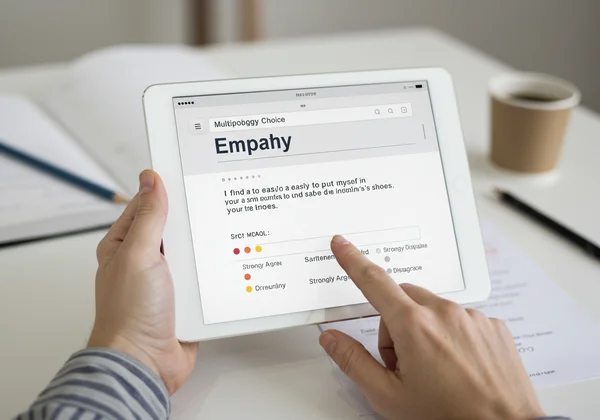
Researchers developed these self-report questionnaires by creating statements that reflect empathetic thoughts, feelings, and behaviors. Participants rate how strongly they agree or disagree with statements like, "I find it easy to put myself in somebody else's shoes" or "I am good at predicting how someone will feel." The responses are scored to produce a single number—your Empathy Quotient. This approach gave us the first standardized tools for this complex trait.
Strengths and Limitations of Self-Reported Empathy Scales
The EQ scale and similar psychometric testing tools are incredibly valuable. They are easy to administer, provide a clear baseline score, and have been validated through extensive research. However, they have limitations. Because they rely on self-reporting, results can be influenced by a person's lack of self-awareness or a desire to present themselves in a favorable light. Furthermore, a single score can oversimplify the rich tapestry of a person's empathetic abilities, missing the subtle nuances.
The Next Frontier: How AI Enhances Empathy Measurement
This is where modern technology comes in, revolutionizing how we approach empathy assessment. The limitations of traditional scales created a need for a more dynamic and personalized tool. AI-driven platforms can analyze patterns in your responses, not just the final answers, offering insights that were previously impossible to capture.
Moving Beyond Simple Scores: The Need for Nuance
A single empathy score is a great starting point, but it doesn't tell the whole story. Are you stronger in cognitive or emotional empathy? How does your empathy manifest in professional settings versus personal relationships? These are the questions that require a deeper, more nuanced analysis. AI excels at identifying these subtle patterns, moving beyond a flat number to create a rich, multi-dimensional empathy profile.
AI-Driven Insights: Personalizing Your Empathy Profile
Instead of just telling you if you're empathetic, an AI-enhanced empathy test can show you how you're empathetic. By analyzing your unique response style across 60 comprehensive questions, the system can highlight your specific strengths, potential challenges, and how these traits likely impact your daily life. It can provide actionable advice tailored to your personal profile, turning a simple quiz into a powerful tool for growth. This is the advantage you get when you take our free test.

Ensuring Accuracy: The Role of Validity and Reliability in AI Assessments
A common question is whether an AI test can be scientifically sound. The answer is a resounding yes, provided it's built on a solid psychological foundation. The principles of validity and reliability are paramount. Validity ensures the test measures what it claims to measure (empathy), while reliability ensures the results are consistent. A well-designed AI test uses established psychological principles as its base and then applies advanced algorithms to deepen the analysis, offering the best of both worlds.
Why a Scientifically Backed Empathy Test Matters
In a world filled with personality quizzes, choosing a scientifically grounded tool is essential. An assessment rooted in psychological principles ensures the feedback you receive is not just entertaining but also meaningful and accurate. This credibility is what transforms a score into a catalyst for genuine self-improvement.
From Theory to Practice: Applying Your Empathy Score
Understanding your empathy profile is the first step. The real magic happens when you apply those insights. A high score in cognitive empathy might make you a great leader, while strong emotional empathy could make you a deeply supportive friend. Knowing your blind spots allows you to consciously work on them. A credible test gives you a reliable map to navigate your inner world and improve how you connect with others. Ready to assess your empathy?
Our Commitment to Credible and Comprehensive Empathy Analysis
We believe that self-discovery should be both accessible and accurate. That's why the online empathy assessment platform is built on established psychological principles. Our free test offers a clear and insightful summary, but our unique, AI-enhanced report provides the deep, personalized analysis needed for transformative growth. We are committed to providing a trustworthy tool that empowers you to understand yourself and others better.
Unlocking Deeper Self-Understanding Through Valid Empathy Assessment
From the bedrock of psychological theory to the cutting edge of AI, the measurement of empathy has profoundly advanced. While traditional scales like the EQ provided a vital framework, modern tools now offer a level of personalization and depth that was once unimaginable. Understanding the science behind these tests empowers you to choose tools that provide real value.
A scientifically valid empathy test is more than a number—it's a mirror reflecting your unique way of connecting with the world. It provides a roadmap for strengthening relationships, excelling professionally, and fostering profound self-awareness. Why not start your journey of discovery today? Discover your empathy score and see what you can learn about yourself.

Frequently Asked Questions About Empathy Measurement Science
How do I know if an online empathy test is scientifically accurate?
Look for tests that state they are based on established psychological principles or validated research scales. A transparent methodology, comprehensive questions (more than just a few), and detailed, nuanced results are also good signs. Credible platforms will avoid making medical diagnoses and focus on self-awareness.
What is the Empathy Quotient (EQ) and why is it important in psychology?
The Empathy Quotient (EQ) is a self-report questionnaire designed to measure empathy. It was a landmark tool in psychology because it provided one of the first standardized, quantifiable methods for assessing this complex trait, paving the way for decades of research into social neuroscience and conditions like autism.
Can AI truly provide deeper insights into empathy than traditional questionnaires?
Yes. While traditional tests provide a valuable score, AI can analyze the complex patterns between your answers. It can identify how your cognitive and emotional empathy interact, pinpoint situational nuances, and deliver personalized feedback that a static scoring system cannot. An AI-powered analysis can create a much richer and more actionable report.
What are the different types of empathy assessed in psychometric tests?
Most psychometric tests for empathy focus on measuring at least two core types: Cognitive Empathy (the ability to intellectually understand someone's feelings) and Emotional Empathy (the ability to share someone's feelings). Some, like ours, also infer Compassionate Empathy, which is the motivation to act on those feelings.
Is our approach to empathy measurement valid and reliable?
Our test is carefully constructed based on widely accepted psychological principles of empathy measurement. The questions are designed to assess different dimensions of empathy consistently. While the free summary provides a reliable snapshot, our optional AI-enhanced report uses advanced analysis to deliver a highly valid and personalized profile of your empathetic strengths and areas for growth. Try the test for yourself.